
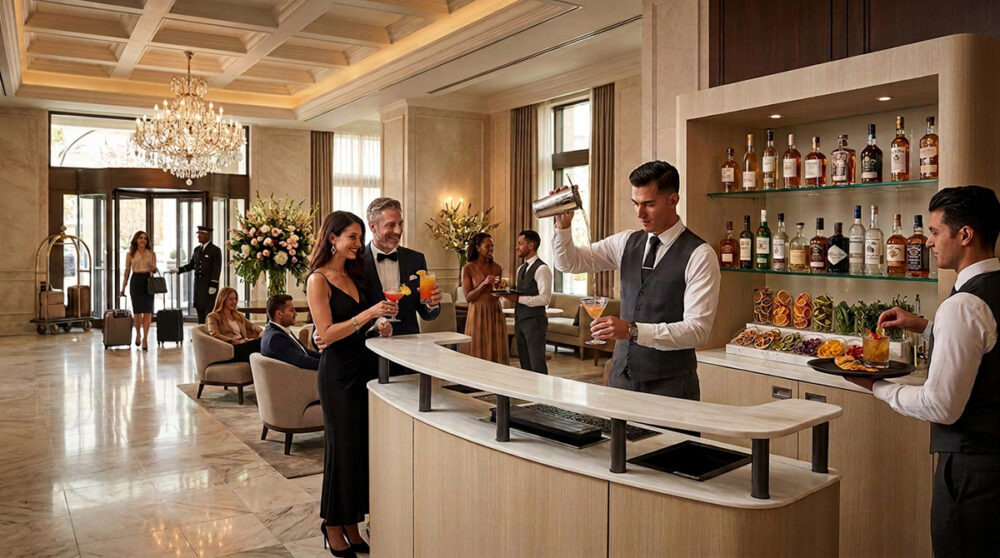
Hotel lobbies are among a property’s most visible and valuable spaces. Yet outside the busiest arrival and departure periods, large portions of that square footage may function primarily as circulation or waiting areas. Commercial mobile bars give food and beverage directors a practical way to activate those spaces during periods of concentrated demand—without permanently changing the lobby or limiting how it can be used later.
Meet Guests Where Demand Already Exists
The best hotel lobby bar ideas begin with guest behavior. Look at when and where people naturally gather: afternoon check-in, conference breaks, the hour before dinner, evening social periods, weekend events, or seasonal patio programming. Instead of asking guests to seek out another outlet, a mobile bar brings beverage service directly into the flow of the property.
Depending on the concept, that activation might be a signature cocktail hour, a wine-and-beer station, a zero-proof menu, a welcome reception, or a pop-up tied to a conference or local event. The goal is not simply to place a bar in the lobby. It is to create a service experience that feels intentional, convenient, and consistent with the property’s positioning.
Why Mobility Changes the Equation
A permanent bar dedicates space to one purpose. Portable hospitality bars can be deployed according to actual demand. A unit may support lobby service on a busy arrival night, move to an appropriate patio setting for a weekend activation, serve a prefunction area during a conference, or become part of a private event in the ballroom. That flexibility allows operators to match beverage service to guest demand while returning the space to its primary use when the activation ends.
Choose a Bar for How You Operate
A premium appearance matters, especially in a hotel lobby, but the bar must also support the team working behind it. Before selecting a unit, evaluate:
- The menu and expected service volume
- Bartender workflow and access to ingredients, tools, glassware, and waste
- Requirements for ice, water, power, refrigeration, rinsing, and storage
- Caster quality, protective bumpers, clearances, and the route to storage
- Countertop, finish, lighting, and architectural compatibility with the property
The right commercial mobile bar should help the bartender work efficiently while presenting a polished, guest-facing experience. Operational details that are easy to overlook during the design process can determine how well the unit performs during a peak service period.
Plan Deployment, Placement, and Design
A mobile bar creates the most value when it is paired with a clear deployment plan. Identify the location, operating window, menu, staffing model, storage route, setup procedure, and success measures in advance.
Start with a defined peak period and track beverage sales, average check, service speed, labor requirements, and guest response. These results can help determine whether to expand the schedule, adjust the menu, or move the activation to another area of the property. In a lobby, a bar becomes part of the interior design. Its shape, materials, lighting, and finishes should complement the surrounding architecture rather than look like temporary equipment brought in for the evening.
Forbes Industries’ Custom Martini Mobile Bar demonstrates how visual impact and beverage-service functionality can work together. Its curved solid-surface countertop and full-perimeter adjustable LED lighting create a distinctive presentation, while integrated ice and condiment stations, a glass rinser, glass chiller, speed rails, water systems, storage, and swivel casters support professional beverage service. The result is a mobile bar designed to function as both an operational tool and a hospitality centerpiece.
When a Standard Bar Is Not Enough
Standard portable hospitality bars can solve many common service needs. A custom solution becomes valuable when the property requires a specific footprint, finish palette, branded presentation, equipment package, service direction, or workflow. Forbes Industries’ Concept to Reality process begins with identifying the property’s business needs, then moves through design approval, engineering, 3D concept development, production, and delivery. That collaborative approach allows the finished bar to reflect both the aesthetic goals of the property and the practical needs of its F&B team.
Put Underused Space to Work
The lobby does not have to remain a pass-through space, and a patio does not have to wait for a permanent service buildout. With the right mobile bar, operating plan, and presentation, hotels can create flexible beverage destinations wherever guests naturally gather.
Explore Forbes Industries’ selection of commercial mobile bars and back bars, or work with the Forbes team to develop a custom F&B solution built around your property, brand, and service goals.